Lisa Röing Baer
spark
With the exhibition spark, Kunstverein Friedrichshafen presents new works by Lisa Röing Baer. She examines how systems continue to bind us even when we recognize their fragility. The exhibition’s point of departure is a sense of paralysis in the face of a changing world, in which awareness of crises coexists with the inert persistence of familiar habits. Between convenience, numbness and the promise of belonging, forms of attachment to larger systems emerge that are both sustained and questioned.
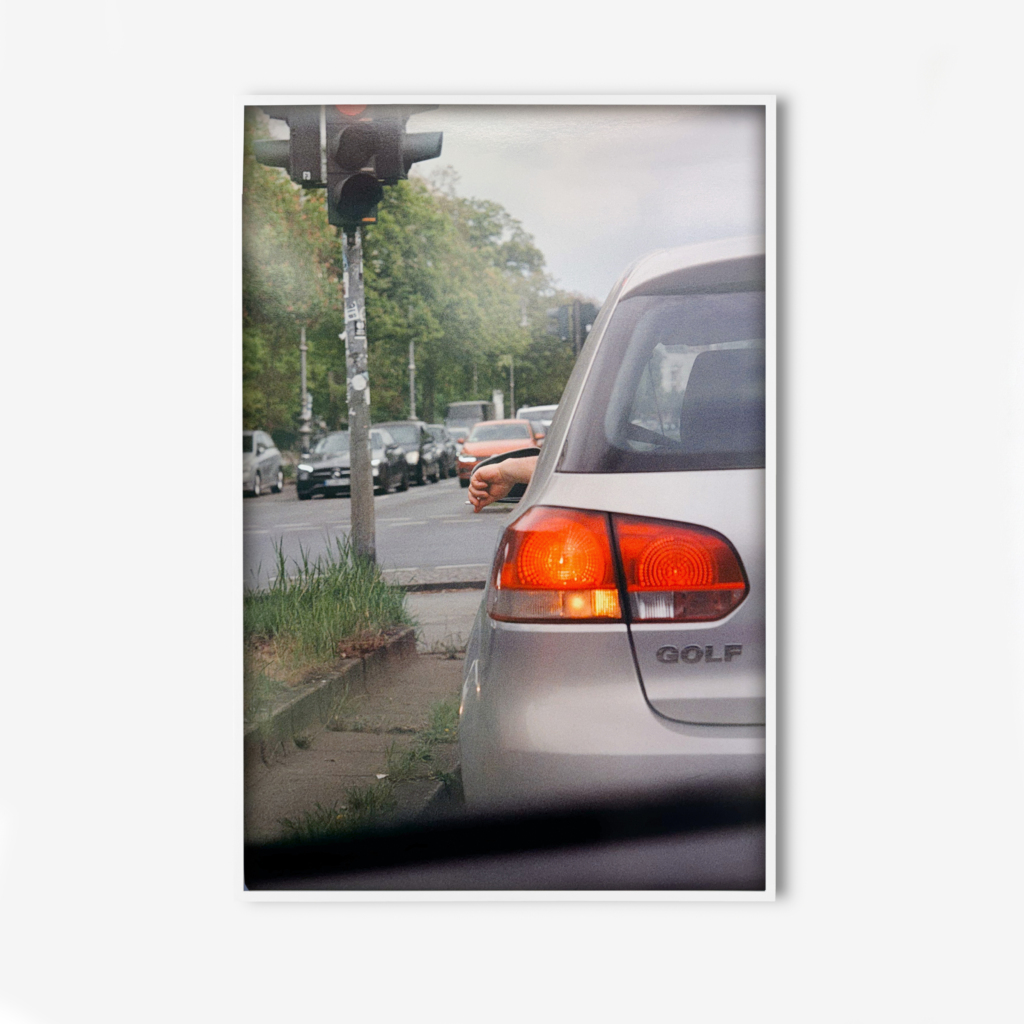
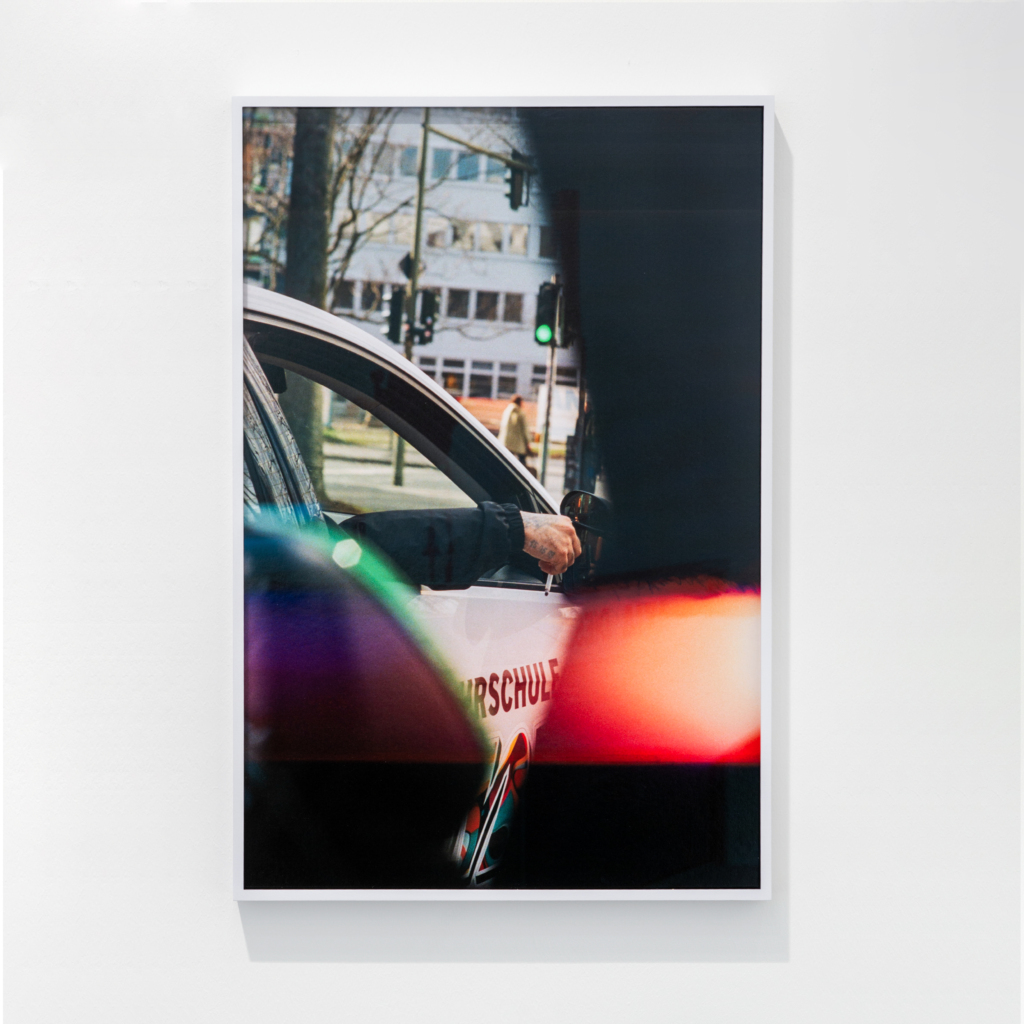
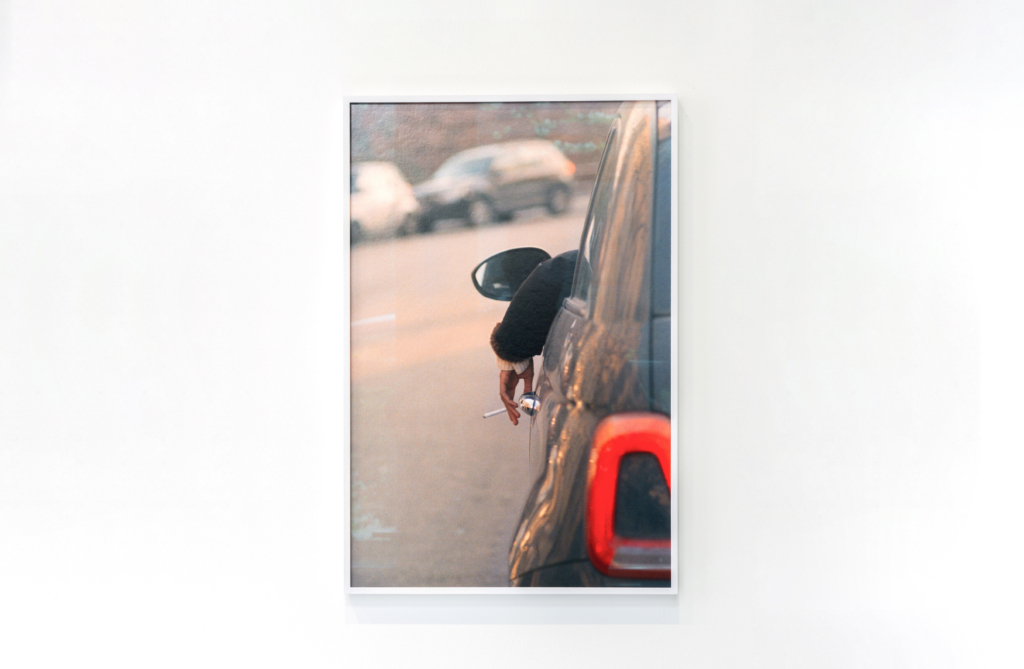
Photography: Dominik Dresel, Lisa Röing Baer, 2026
Akrasia¹ is a term that describes a long-familiar state of mind: acting against one’s better judgment, continuing despite insight. For Lisa Röing Baer, dependency emerges as the fundamental condition of this exhibition. It is quiet, continuous, often barely perceptible, and precisely in this lies its power, at times agonizing. In spark, Röing Baer makes such submission visible: something that continues even once it has been recognized, a movement that cannot be interrupted even though it has long been understood.
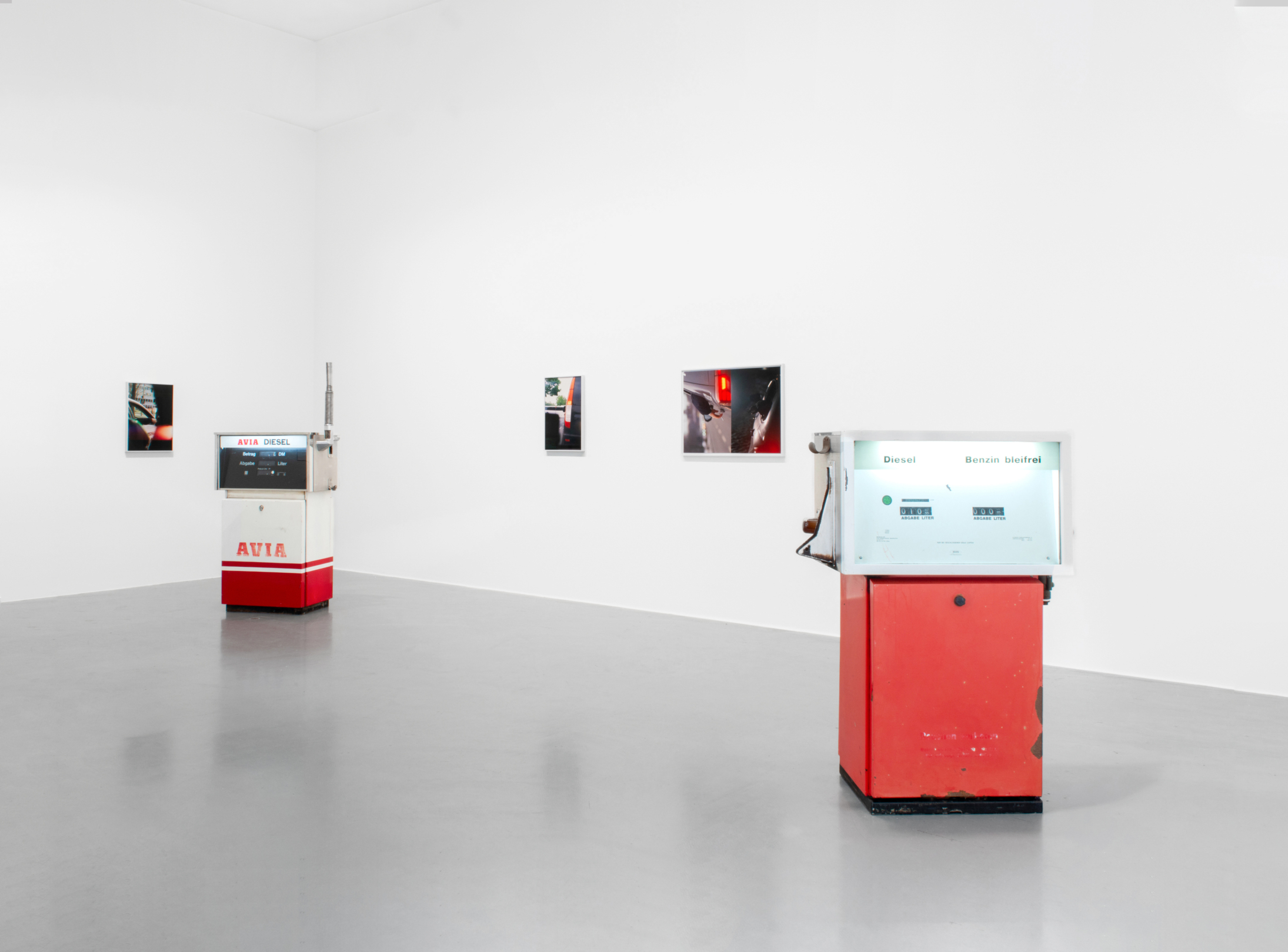
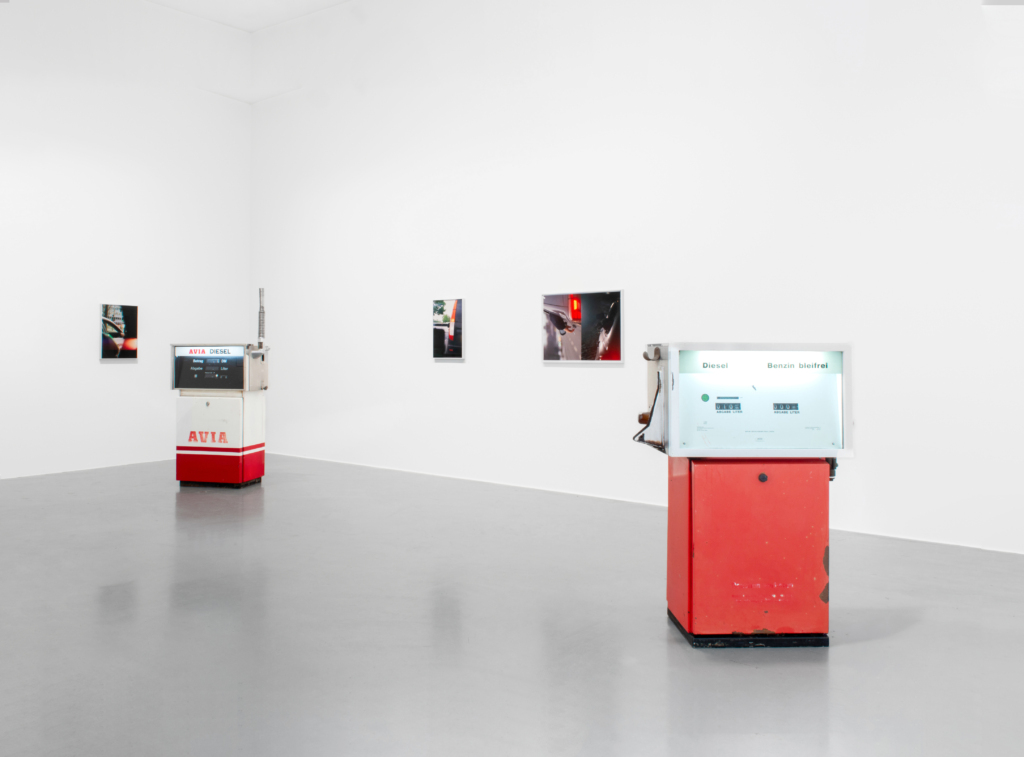
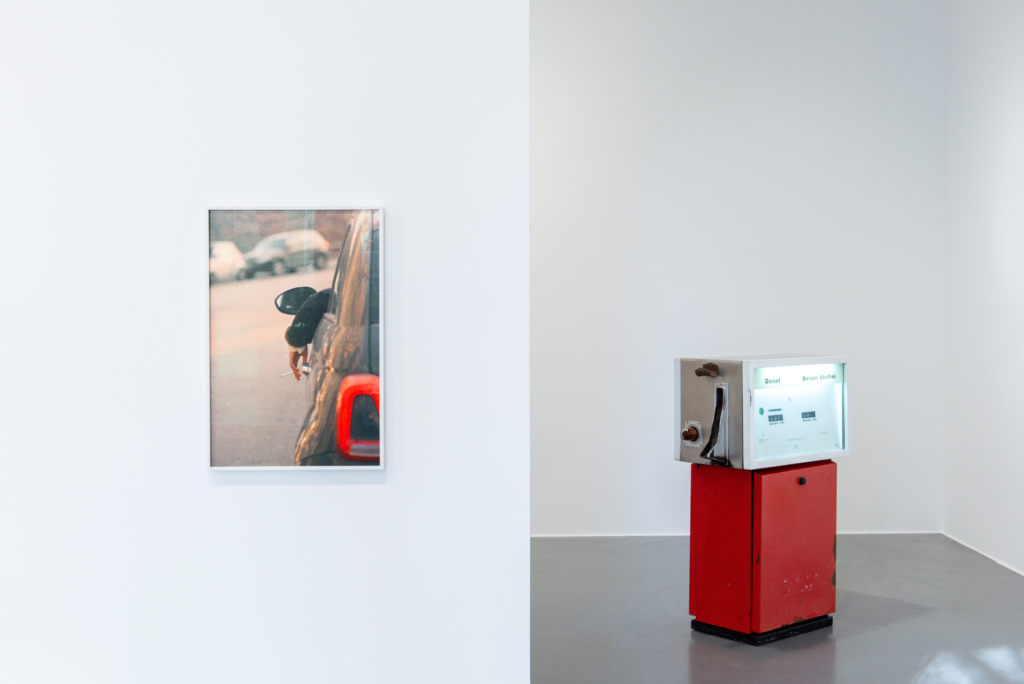
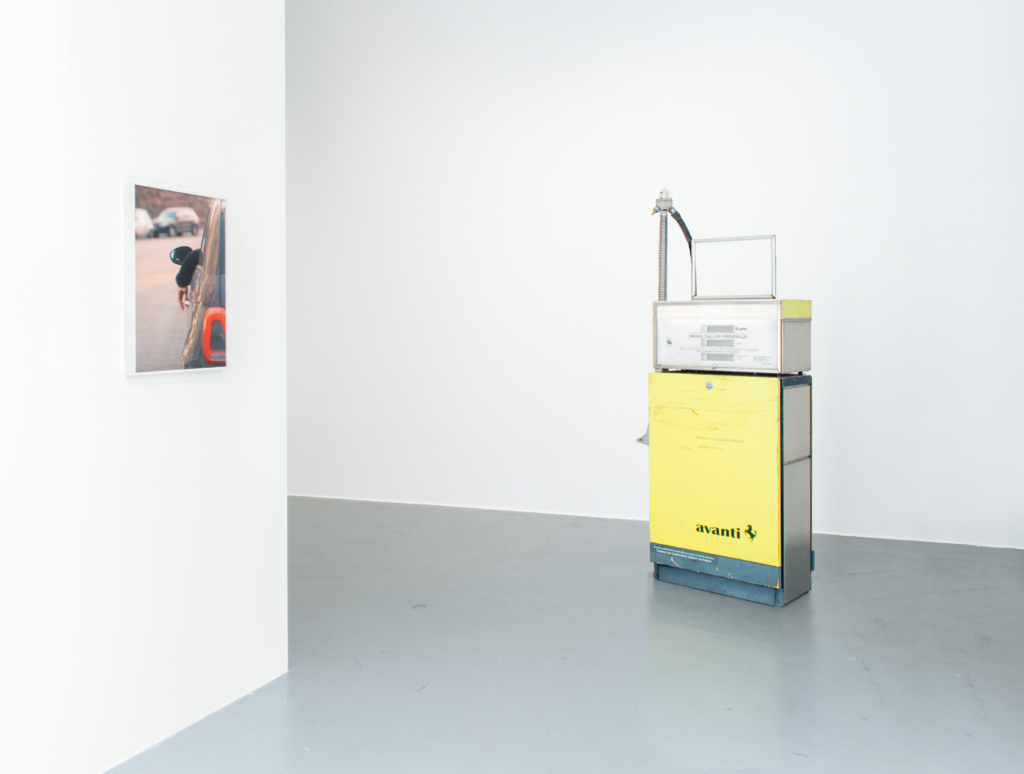
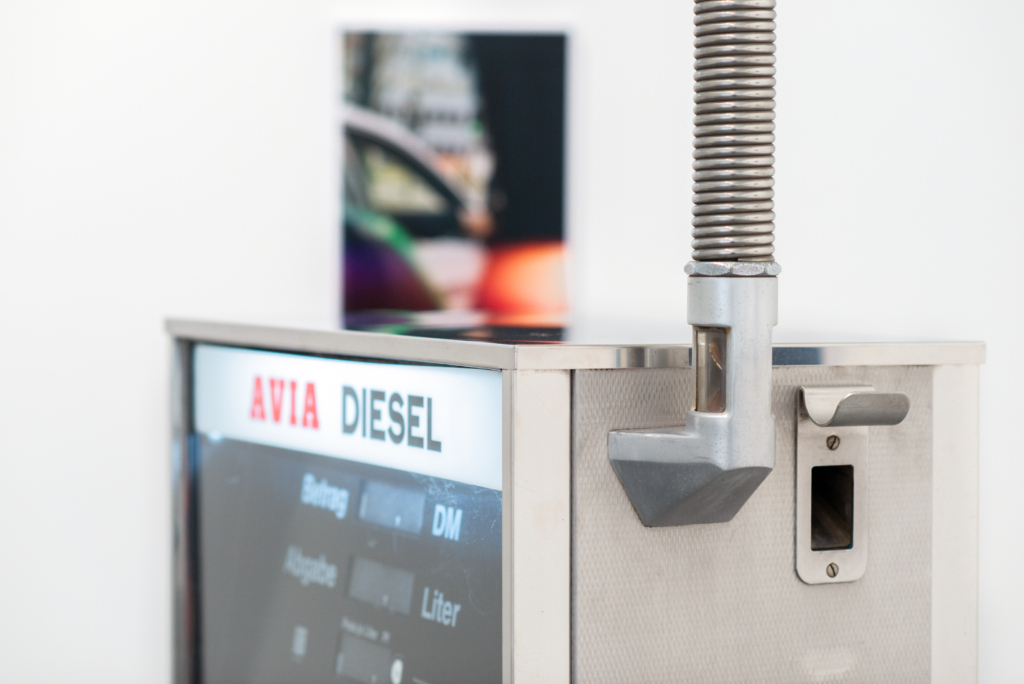
Gas stations have become symbols of a present that can no longer be outsourced. They appear on newspaper front pages, acting as interfaces between everyday life and systemic structures. A brief stop, the grasp of the fuel nozzle. Within this gesture lies a social order that perpetuates itself, almost unnoticed. Gas pumps loom in the space like relics. They are models from the heyday of petromodernity², from a time when oil promised unrepentant progress, mobility, and freedom. They still embody this narrative: broad-shouldered and upright, their almost human presence exudes a silent authority. Their form suggests a mute presence. They encapsulate a masculinity closely tied to energy, control, and resources. Petromasculinity³ describes a structure of power, consumption, and persistence. The pumps resemble guardians, tasked with preserving an order that has already begun to shift. Their duality holds time in a suspended simultaneity, a glance backward, a glance forward, a gaze into the future, yet without movement.
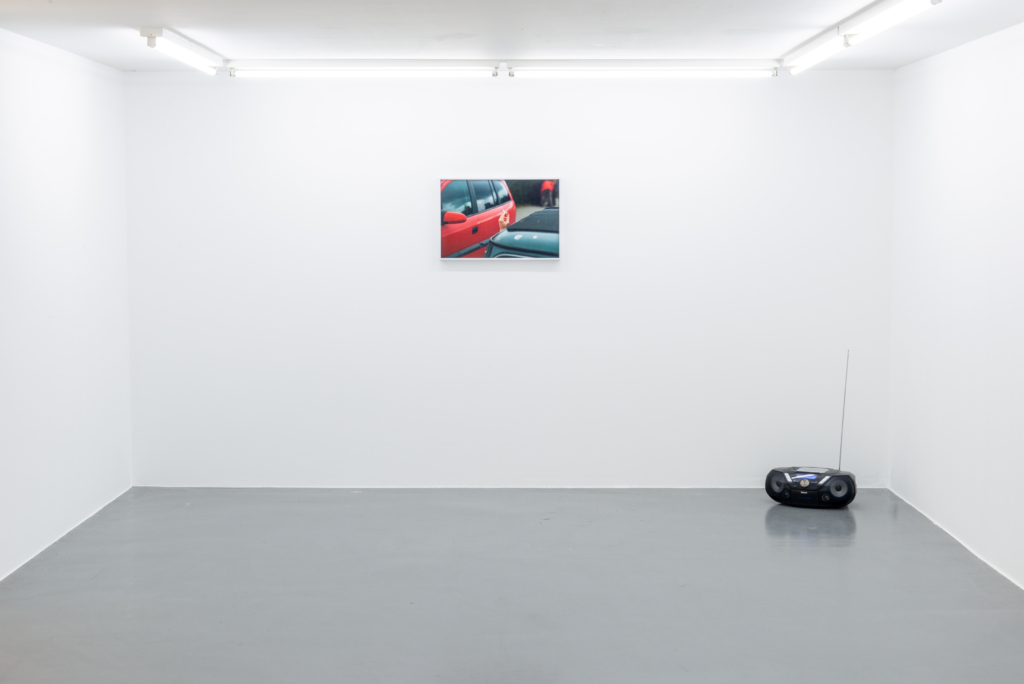
Photographs shift these structures into the realm of the everyday: hands extending from car windows, cigarettes between fingers. A fleeting moment, an incidental image, and yet within this gesture lies a similar logic: consumption, repetition, dependency. The camera itself is situated in the same dilemma as the situation it depicts. At the edges of some images, fragments of a car’s interior appear. The very vehicle from which the artist photographs. She is part of the situation, embedded in the dynamics of mobility and consumption. Röing Baer does not appear visibly in the images, yet she remains part of a system that both holds and interrogates her.
In one pair of images, two hands encounter one another. They relate without touch: distant, yet bound by their shared gesture. The gaze moves between them, searches for stability, finds it briefly, and loses it again.
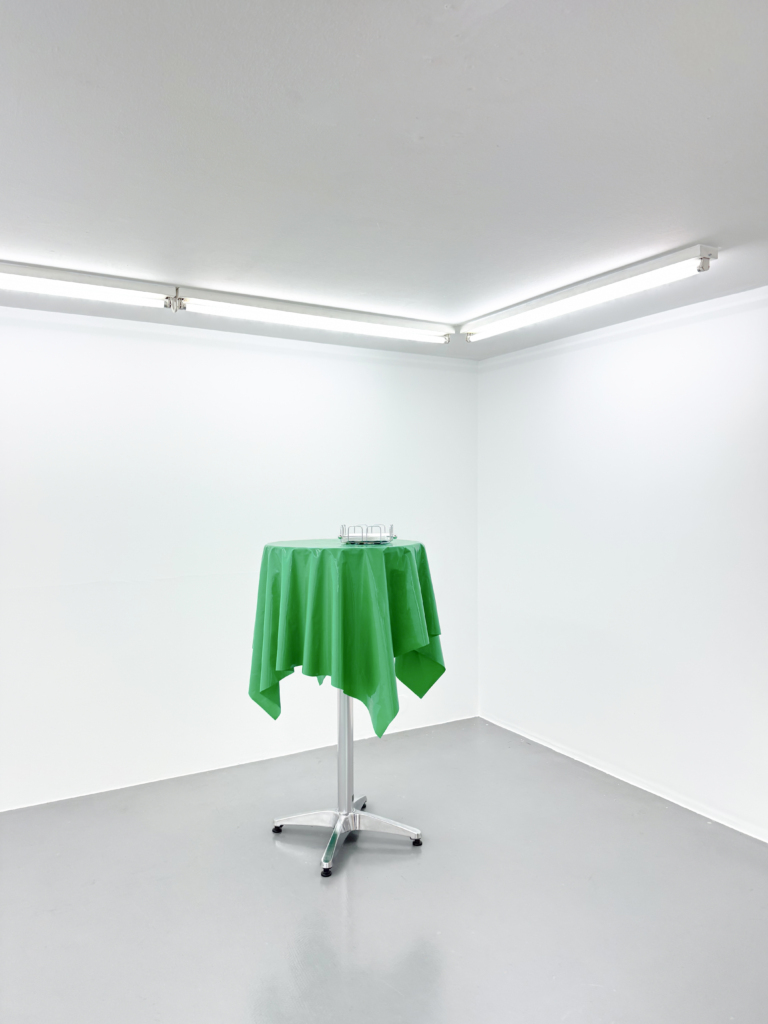
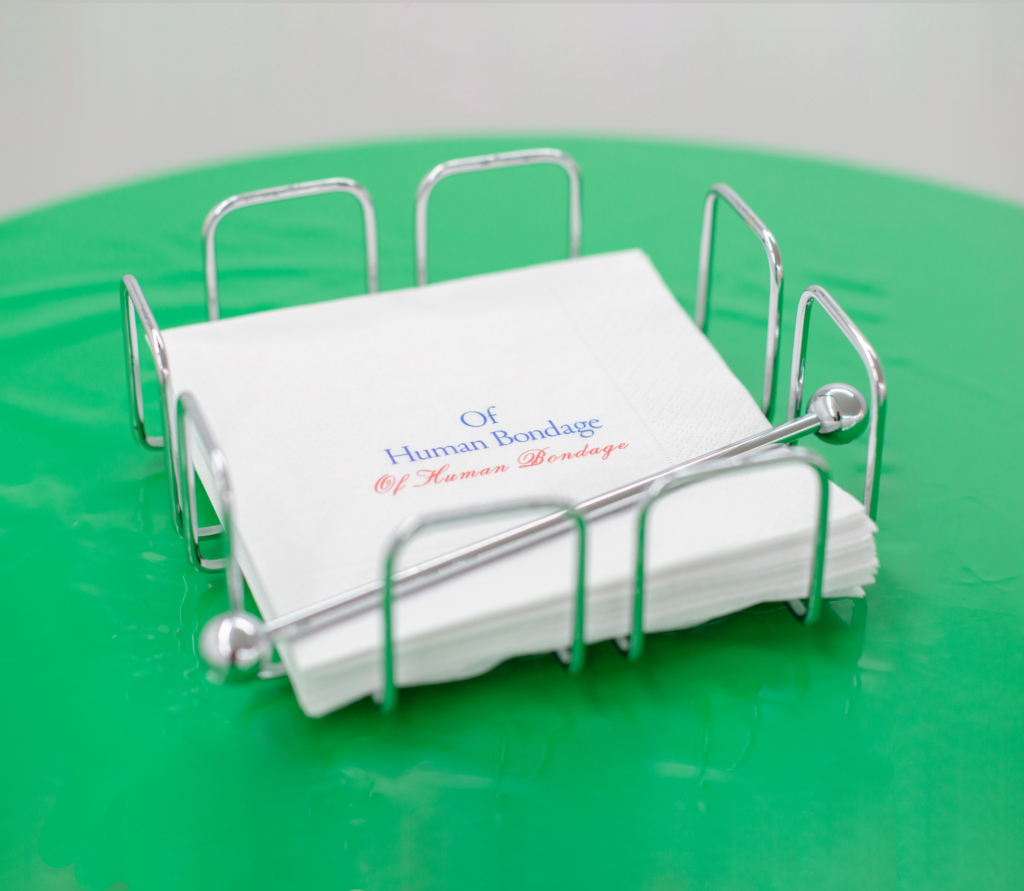
The desire for encounter, for touch, and for connection extends into the upper floor. A round standing table promises gathering and exchange, a space to process what has been seen. One finds oneself in the interior of a gas station, at its snack counter, or at an adjacent rest stop. Delicately printed napkins offer a clue as to where one might be. On them, it reads: Of Human Bondage. In Somerset Maugham’s novel of the same name, we follow the life of Philip, who, for years, clings to his love for a woman who treats him miserably, despite all reason. The story resonates strongly with the fragile hand emerging from the machine car, clinging to a cigarette, a hopeful attachment to a harmful relationship. For belonging and comfort, one gives up a great deal.
All these situations carry an underlying tension. What lingers when encountering the fuel pumps and cigarette stubs, when the faint smell of petroleum tickles the nose, is the smoldering danger of their explosive combination. In Röing Baer’s work, fire becomes both an explicit threat and a possibility. While it carries destructive force, it also holds the power to dissolve existing structures. Can dependency, can this state of being subjected, be confronted with anger? For the first time in her practice, the potential for rupture emerges as an explicit theme. In place of observing the status quo, a disruptive moment appears, a gesture of resistance. Everything is in place, except for the moment it all ignites: spark.
Lisa Röing Baer works with analog photography and develops multimedia exhibitions from her ongoing image archive, in which photographs, objects, and texts are placed in new constellations. She studied at the Kunstakademie Düsseldorf under Christopher Williams and graduated in 2022 as a Meisterschülerin. In 2025, she published her first monograph Der Boden knirscht unter meinen Füßen with Kerber Verlag. In the same year, she presented the solo exhibition Column at EIGEN ART LAB and participated in the group exhibition Perspektivwechsel at the Stadtmuseum Düsseldorf. In 2026, she presented her monograph at Kunsthalle Düsseldorf.
On the occasion of the exhibition, Lisa Röing Baer and Kunstverein Friedrichshafen present the photo edition napkin.
The performance program accompanying the exhibition is supported within the framework of Literatursommer 2026, a program of the Baden-Württemberg Stiftung:
www.literatursommer.de
Footnotes
¹ Akrasia, Ancient Greek ἀκρασία, akrasia, Latin incontinentia: weakness of will, lack of self-control, acting against one’s better judgment.
² An epoch in which the scientific and technological use of fossil resources profoundly shapes the conditio humana at a structural level.
³ Petromasculinity describes the entanglement of white, hegemonic masculinity with a persistent attachment to fossil fuels, climate change denial, and authoritarianism. The term petro-masculinity was coined by the American political scientist Cara Daggett.